 Canada
 United States
 United Kingdom
 Nigeria
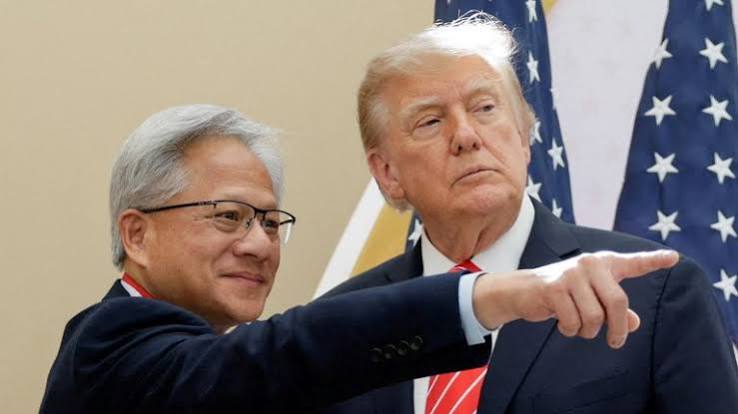
US President Donald Trump has confirmed that the Federal Bureau of Investigation (FBI) is looking into the relationship between Nvidia Chief Executive Officer, Jensen Huang, and a woman suspected by US intelligence officials of spying for China.
Trump disclosed this on Monday, saying he had spoken with Huang following reports that the Nvidia boss may have been targeted in a Chinese espionage operation.
According to the president, Huang denied knowing that the woman, identified as Alice Huang, was allegedly involved in espionage.
“I asked him that question, ‘Did you have any idea she was a spy?’ He said, ‘I had no idea she was a spy,’ and I really believe him,” Trump told reporters.
FBI Investigating Alleged Espionage Links
Speaking later at a White House briefing, Trump confirmed that the FBI was investigating the matter but did not disclose when the probe began or provide details about its scope.
He described Huang as an “honourable guy” and expressed confidence that the Nvidia chief would emerge in good standing after the investigations.
The FBI declined to comment when contacted by the BBC.
China has rejected the allegations, with its Foreign Ministry describing claims that Huang was targeted in an espionage campaign as “entirely groundless, speculative and intended to smear and malign China”.
Nvidia Launches Independent Investigation
Nvidia said it had commissioned an independent investigation into the matter involving Alice Huang, who is reportedly not related to Jensen Huang.
The company maintained that it had no reason to believe its trade secrets or US national security interests had been compromised.
According to a New York Times report cited by the BBC, US intelligence officials believe Alice Huang, also known as Huang Le, was working for Beijing. She reportedly served as managing director of Singapore-based company Megaspeed, which had business dealings with Nvidia.
The report also said US Secretary of State Marco Rubio sent a memo to senior officials in Washington in the spring, warning about Jensen Huang's close relationship with a suspected Chinese intelligence operative.
Nvidia Shares Lose $250bn in Market Value
The revelations triggered a decline in Nvidia's share price on Monday, wiping approximately $250bn from the company's market value after its stock fell by more than four per cent.
Nvidia, the world's second most valuable company after Apple, designs advanced computer chips that power artificial intelligence technologies and have become central to the competition between the United States and China.
The controversy has raised national security concerns in Washington because of the strategic importance of Nvidia's technology and restrictions on the export of advanced chips to China.
Shareholders File Lawsuit Against Nvidia
Also on Monday, Jensen Huang and Nvidia were named in a proposed class-action lawsuit filed in California.
The lawsuit accuses the company and its chief executive of misleading shareholders by concealing his relationship with Alice Huang, who is suspected of seeking to help smuggle Nvidia products into China.
The BBC reported that the lawsuit also alleges Nvidia misrepresented the relationship in statements to the media. The claims have not been established in court.
Meanwhile, Huang has acknowledged being unfaithful to his wife and apologised for hurting her and their children.
He said he remained committed to protecting Nvidia and supporting US national security, adding that he would cooperate with the company's investigation.
Huang has also been asked to appear at a closed-door briefing involving several congressional committees next week to discuss Nvidia's security protocols and his reported interactions with Alice Huang. It remains unclear whether he will attend.
US-China AI Rivalry Raises Stakes
The investigation comes amid growing competition between Washington and Beijing over artificial intelligence and advanced semiconductor technology.
Huang has previously opposed broad restrictions on Nvidia's chip sales to China, arguing that US technology should remain competitive in the global AI market.
Although the Trump administration announced in January that Nvidia could sell its H200 chips to approved Chinese customers under certain conditions, the company's most advanced AI semiconductors, including the GB200 Blackwell superchip, remain restricted from the Chinese market.
BBC News