 Canada
 United States
 United Kingdom
 Nigeria
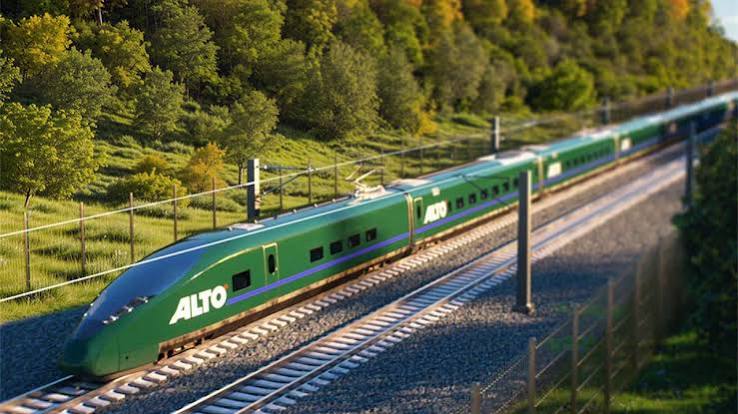
Ottawa Proposes Expanded Land-Seizure Powers for Canada's Alto High-Speed Rail Project
Proposed changes could reduce existing protections for landowners along the Toronto–Quebec City corridor
The Canadian federal government is proposing sweeping changes to land acquisition rules for the country's planned Alto high-speed rail project, including provisions that could allow private property to be expropriated with fewer of the safeguards traditionally required under Canadian law.
The proposed measures, included in the government's draft Budget 2026 implementation legislation, would give the project special powers to acquire land, transfer ownership directly to a private consortium and resolve certain disputes involving farms and municipal roads through private arbitration.
The Alto project is designed to connect Toronto and Quebec City with a high-speed rail service. However, its proposed route has faced opposition from farmers, private landowners and some municipal governments concerned about the impact on their properties and communities.
Under the draft legislation, Alto would receive exemptions from several existing laws, including the Expropriation Act, key sections of the Railway Safety Act and Impact Assessment Act, as well as provisions of the Railway Relocation and Crossing Act.
Municipal and land-use planning lawyer Ajay Gajaria described the scale of the proposed acquisition powers as unprecedented in modern Canadian history, warning that thousands of properties could potentially be affected.
"Both in terms of dollar value and the number of private properties required, in my view, it will be the largest expropriation project in modern Canadian history," Gajaria said.
Alto declined to comment on the proposed legislative changes.
Proposed Changes to Expropriation Rules
When Parliament passed the High-Speed Rail Network Act through Bill C-15 in March, it introduced specific exceptions intended to speed up the project. These included allowing Alto to bypass initial purchase negotiations and replace public hearings with written objections, while retaining the framework of Canada's Expropriation Act.
The latest proposals would go further by removing additional oversight and allowing the government to transfer ownership of acquired private property directly to a third party.
The changes are contained in a 521-page notice of ways and means motion published on November 20.
One of the provisions attracting particular concern would allow the government to secure property rights for up to eight years through a right of first refusal. It could also impose a prohibition on certain work on a property for up to four years before deciding whether to proceed with expropriation.
Gajaria said the proposed expansion of ministerial discretion would allow the minister to consider a broad range of factors, including the public interest, before issuing a work prohibition.
He warned that such restrictions, if widely applied, could make it difficult for affected owners to sell their properties or attract buyers. A potential purchaser may be discouraged by the government's ability to match the best offer through its right of first refusal.
Landowners Could Face Restrictions on Property Improvements
The proposed four-year work prohibition could prevent property owners from undertaking significant activities without special permission from the transport minister.
Restrictions could cover new construction, major extensions, excavation and substantial improvements to a house or land. The draft legislation also provides that any increase in property value resulting from work carried out during the restricted period would not be included in the eventual expropriation compensation.
Another proposed change concerns the legal consequences of incomplete expropriation notices. Under the existing framework, a landowner could challenge a notice in court if it failed to clearly identify the portion of property being acquired.
Changes introduced in March allowed officials to correct defective notices and backdate those corrections to the original filing date. The new proposal would go further by providing that a notice failing to specify the land being taken could automatically capture all of the owner's property rights, while extinguishing existing easements, leases and rights-of-way.
Gajaria acknowledged that owners whose properties are ultimately expropriated would likely receive compensation. He said the principle of expropriation for public projects should include full and fair payment for the affected property.
Farmers and Municipalities Face Crossing Disputes
The proposed legislation also addresses how access crossings would be handled where the railway divides private farms or affects local roads.
Under traditional Canadian railway law, farmers whose land is divided by a freight railway can seek a crossing. The Canadian Transportation Agency can also require a railway operator to construct and fund a level crossing.
However, high-speed trains travelling at speeds of up to 300 kilometres per hour require stricter safety arrangements. Crossings along the proposed route would need to be grade-separated, meaning roads and access routes would pass over or under the railway rather than cross the tracks at the same level.
Under the proposed changes, disputes involving affected farms and municipalities would be referred to private arbitration. The parties could be required to share costs, with each side paying up to $25,000 in arbitration expenses, in addition to their own legal fees.
Arbitrators would also have the authority to allocate part of the costs of constructing or maintaining crossings to landowners.
Gajaria questioned the fairness of requiring individual property owners to shoulder such expenses, particularly where the costs could be substantial.
Alto has previously said it does not intend to divide communities or sever federal and provincial highways, and that it plans to use overpasses and underpasses where possible.
Project's Economic Benefits and Political Opposition
A recent study commissioned by Alto estimates that the proposed railway could generate approximately $24.5 billion in economic benefits annually once operational. The study attributes the projected gains to improved connections between people living and working along the Toronto–Quebec City corridor, with potential productivity improvements.
The federal government has described the project as an important response to Canada's growing transportation needs and part of a wider plan to modernise national infrastructure.
However, the proposed land acquisition powers have become a major point of disagreement among political parties. The Conservative Party and Bloc Québécois have opposed the project, citing concerns over the planned expropriations.
The New Democratic Party supports the development of high-speed rail in Canada but has expressed reservations about the extent of the powers being proposed by the government.
NDP Leader Avi Lewis said expropriation could sometimes be necessary for major infrastructure projects, but should remain a last resort.
"Some of it's going to be public land, some of it's gonna be private land ... but we need these projects. It's a vast country," Lewis said.
The proposed legislation has therefore placed the project's transportation and economic objectives alongside questions about property rights, public oversight and the responsibilities of government when private land is required for major infrastructure development.
Source: CBC News