 Canada
 United States
 United Kingdom
 Nigeria
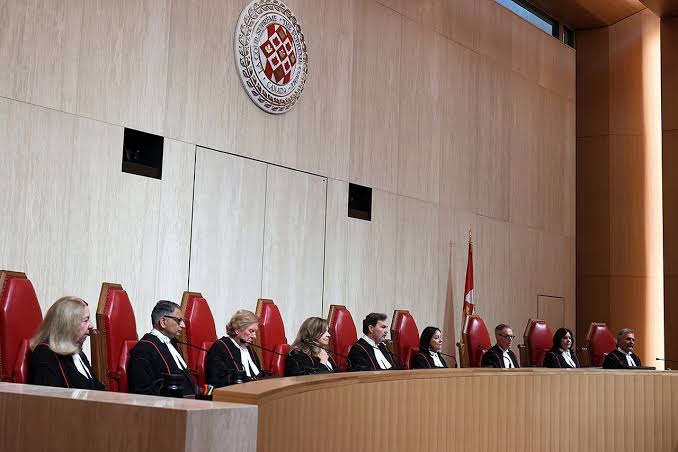
Canada’s Supreme Court Set to Rule on Quebec’s Controversial Bill 21
Decision could clarify the limits of the notwithstanding clause and the protection of fundamental rights
Canada's Supreme Court is set to deliver a closely watched ruling on Quebec's controversial secularism law, Bill 21, in a decision that could influence how fundamental rights are protected across the country.
The law prohibits certain public sector employees, including teachers and police officers, from wearing religious symbols while performing their duties. The central issue before the court is whether Quebec can continue relying on the Constitution's notwithstanding clause to shield the legislation from certain Charter-based challenges.
The court has scheduled the release of its decision for 9:45 a.m. Eastern Time on Friday, November 27.
Why the Notwithstanding Clause Matters
The notwithstanding clause allows federal or provincial governments to keep certain laws in force despite some protections under the Canadian Charter of Rights and Freedoms. Its use has become the central focus of the legal challenge against Bill 21.
Rather than simply deciding whether the law's restrictions on religious symbols are justified, the Supreme Court is being asked to consider the extent to which governments can use the clause to avoid judicial scrutiny of legislation that may violate fundamental rights.
Karine Millaire, a law professor at Université de Montréal who represents the International Commission of Jurists in the case, said the ruling may not settle every question surrounding the clause.
“It will not be the end of the conversation on Friday.”
Millaire noted that the Supreme Court is scheduled to hear another challenge involving the notwithstanding clause in March, this time concerning Saskatchewan's policy on students' names and pronouns in schools.
She said the court could clarify whether governments face limits when invoking the clause and whether judges can formally recognise violations of fundamental rights even when the legislation remains protected from certain legal challenges.
Background to Quebec's Bill 21
Quebec adopted Bill 21 in June 2019 under the Coalition Avenir Québec government. The legislation established rules on state secularism, including restrictions on religious symbols for certain public employees.
The law quickly faced constitutional challenges from civil liberties organisations, which argued that it discriminates against religious minorities, particularly Muslim women who wear head coverings.
In April 2021, the Quebec Superior Court found that Bill 21 violated the basic rights of religious minorities but ruled that those violations were permissible because the provincial government had invoked the notwithstanding clause.
In 2024, the Quebec Court of Appeal upheld most of that decision and overturned an earlier exemption that had applied to English-language school boards.
The case has now reached Canada's highest court, with the constitutional implications extending beyond the specific restrictions contained in Quebec's legislation.
Supporters and Critics Present Their Arguments
Both supporters and opponents of Bill 21 are looking to the Supreme Court for clarification, although they approach the case from different perspectives.
Daniel Baril, president of the Mouvement laïque québécois, said he was cautiously optimistic about the ruling. He pointed to a 2015 Supreme Court decision involving prayer at municipal council meetings, in which the court emphasised the state's responsibility to remain religiously neutral.
Baril believes that principle supports the position behind Quebec's secularism law. However, the 2015 ruling dealt specifically with prayer during public council meetings and did not determine whether public employees could wear religious symbols.
Meanwhile, Stephen Brown, chief executive of the National Council of Canadian Muslims, said the case raises questions about whether governments can restrict Charter rights without providing justification or facing meaningful judicial review.
“If politicians can play wedge politics with our rights, we don't have rights — what we actually have are permissions.”
Harini Sivalingam, director of the equality programme at the Canadian Civil Liberties Association, also described the case as one of major constitutional importance. She said its implications extend beyond Quebec, particularly as other provinces consider or use the notwithstanding clause in disputes involving different public policies.
Potential Impact Beyond Quebec
The ruling could have consequences for governments across Canada, depending on how the Supreme Court interprets the scope and limits of the notwithstanding clause.
The decision is also expected to carry political significance in Quebec, where the Parti Québécois now leads a minority government and has pledged to extend restrictions on religious symbols further, including to elementary school students.
For legal observers, the outcome could help define the relationship between elected governments, the courts and the constitutional rights of Canadians. It may also influence future challenges involving the use of the notwithstanding clause in other provinces.
While the ruling is expected to provide important legal direction, observers say it may not end the wider debate over secularism, religious freedom and the limits of government authority in Canada.
Source: CBC News